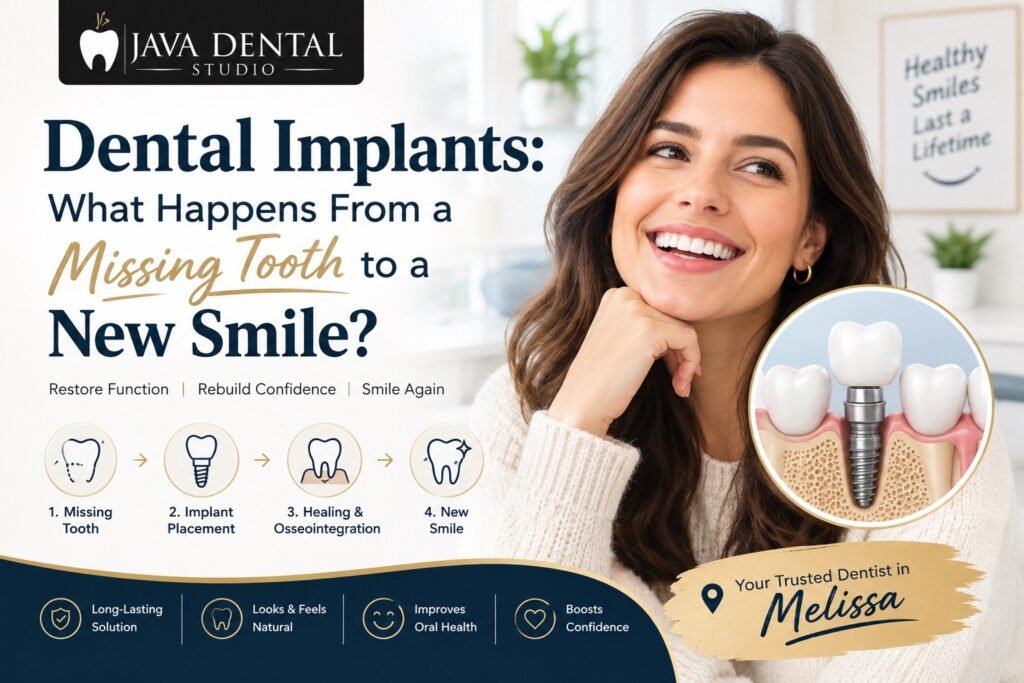
A missing tooth can affect chewing, speech, the way nearby teeth come together, and the bone that once supported the tooth root.
For some people, replacing the missing tooth is primarily about restoring appearance. For others, it is about rebuilding function and creating a more stable foundation for the future.
Dental implants are one option for replacing missing teeth because they address more than the visible part of the tooth. An implant is placed into the jawbone and serves as an artificial tooth root, which can then support a crown, bridge, or denture.
But an implant is not simply a replacement tooth that gets placed in one appointment.
It is a process involving planning, surgery, healing, restoration, and ongoing maintenance. If you are thinking about getting dental implants in Melissa, this guide is for you.
What Exactly Is a Dental Implant?
A dental implant is a small post, commonly made from titanium, that is surgically placed into the jawbone.
Once the implant has healed and integrated with the surrounding bone, it can support a replacement tooth.
The finished restoration generally has three main components:
The Implant
This is the portion placed into the jawbone. It functions similarly to a tooth root.
The Abutment
The abutment connects the implant to the visible restoration.
The Crown
For a single missing tooth, a custom crown is typically attached to the implant and abutment. The crown is the part designed to resemble the visible portion of a natural tooth.
For multiple missing teeth, implants can instead support a bridge or another type of restoration.
This makes implant treatment adaptable to different patterns of tooth loss.
Why Does the Implant Need to Heal?
One of the most important concepts in implant dentistry is osseointegration.
That is the process in which bone grows around and bonds with the implant surface, creating a stable foundation.
It is also why implant treatment cannot always be completed in a few days.
The implant may be placed first, followed by a period of healing before the final restoration is attached. Depending on the patient’s situation, additional procedures may also be needed.
Implant treatment can take several months, with much of that time involving bone healing and growth.
The waiting period can feel frustrating, but the biology is important. The goal is not simply to put a replacement tooth into the mouth quickly. The goal is to allow the supporting structures to heal appropriately.
Who May Be a Candidate for Dental Implants?
Dental implants can be appropriate for many adults who have lost one or more teeth, but candidacy is not determined by tooth loss alone.
A dental professional may evaluate:
- The amount and quality of available jawbone
- Gum and periodontal health
- The location of the missing tooth
- Overall oral health
- Existing dental conditions
- Certain medical conditions or medications
- Smoking or tobacco use
- Ability to maintain good oral hygiene
- The type of restoration being considered
Adequate bone is important because the implant needs a stable foundation. If there is not enough bone in the planned implant area, bone grafting may sometimes be considered.
That does not mean having bone loss automatically rules out implants.
It means the treatment plan may need another step before implant placement.
What Happens If There Isn’t Enough Bone?
Bone loss can occur after a tooth has been missing for some time.
If the jawbone is too thin or lacks sufficient volume in the intended implant area, a dentist may discuss bone grafting or another approach to rebuilding the site.
A graft essentially provides material that can support new bone formation.
Healing takes time, and the amount of time needed depends on the individual case.
This is one reason an implant consultation should include careful evaluation rather than assuming every missing tooth can be replaced in exactly the same way.
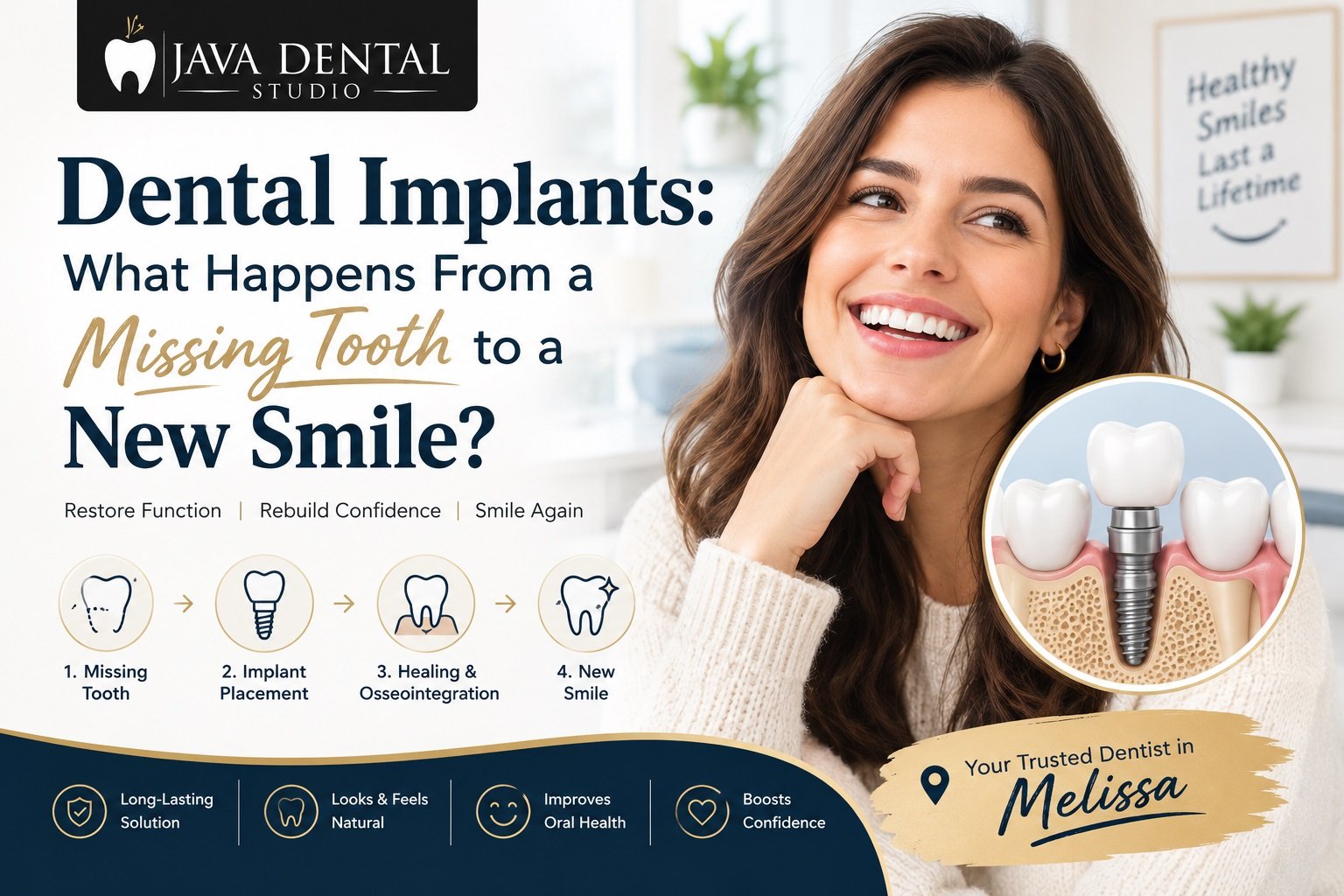
What Does the Implant Process Usually Look Like?
Although treatment varies, the process commonly follows several stages.
1. Examination and Planning
The first stage is understanding the condition of the missing tooth area and the rest of the mouth.
Imaging may be used to evaluate bone and surrounding structures and to plan implant placement.
The dentist also needs to understand your goals and whether an implant-supported restoration is appropriate.
2. Preparing the Site
If the tooth is still present but cannot be saved, extraction may be necessary.
Some patients may also need treatment for gum disease or other oral health problems before implant placement.
If additional bone is required, grafting may be planned.
3. Implant Placement
The implant is placed into the jawbone during a surgical procedure.
The gum tissue is then allowed to heal while the implant begins integrating with the surrounding bone.
4. Healing and Osseointegration
This is the biological phase of treatment.
Bone gradually develops around the implant, creating the foundation needed to support the restoration.
The length of this phase varies.
5. Attaching the Restoration
Once the implant has healed appropriately, the abutment and replacement tooth can be placed according to the treatment plan.
For a single missing tooth, this may be an implant-supported crown.
For multiple missing teeth, the implant may support a bridge or another restoration.
How Long Do Dental Implants Take?
There is no single timeline that applies to every patient.
A straightforward case may move through treatment more quickly than a case involving extraction, bone grafting, gum treatment, or other procedures.
Implant treatment is a process that can take several months because healing and bone growth are integral parts of the procedure.
This is worth remembering when comparing implant treatment with other tooth-replacement options.
The fastest treatment is not automatically the most appropriate treatment.
The timeline should be based on what your mouth needs to create a suitable foundation for the restoration.
Are Dental Implants Better Than Dentures or Bridges?
There is no single tooth-replacement option that is ideal for everyone.
Dental Implants
Implants replace the tooth root and can support individual crowns, bridges, or dentures. They are fixed in the jaw rather than being removable like traditional dentures.
Dental Bridges
A bridge can replace one or more missing teeth by using neighboring teeth or implants for support, depending on the design.
Dentures
Partial or complete dentures can replace several or all missing teeth and are removable.
The right option depends on factors such as the number of missing teeth, bone and gum health, neighboring teeth, overall health, personal preferences, treatment goals, and budget.
A dental consultation can help compare these choices based on your individual situation rather than assuming one treatment is automatically superior.
Do Dental Implants Feel Like Natural Teeth?
An implant-supported tooth can provide a stable chewing surface and may feel more secure than a removable denture.
However, it is important to understand that an implant is not a natural tooth.
It does not contain the same nerves and biological structures as a natural tooth. The surrounding gum and bone also require care.
The goal is to create a functional replacement that integrates with the mouth, not to recreate every biological feature of a natural tooth.
Do Dental Implants Last Forever?
Implants can have long-term survival, but no responsible dentist should promise that an implant will last forever.
Long-term outcomes depend on multiple factors, including oral hygiene, gum health, biting forces, smoking, general health, the quality of the supporting bone and tissues, and regular professional maintenance.
Long-term research has shown that some individual implants can remain functional for decades.
An American Dental Association report, for example, discussed a small long-term study in which 95.6% of evaluated single-tooth implants survived after approximately 38 to 40 years. However, this was a specific study population and should not be interpreted as a guarantee for every patient.
The important takeaway is simpler:
Implant placement is not the end of dental care.
It is the beginning of maintaining a new restoration and the tissues around it.
Can Dental Implants Fail?
Like any medical or dental procedure, implant treatment has risks.
Possible complications can include infection, problems involving surrounding structures, nerve-related symptoms, sinus complications in certain upper-jaw cases, and failure of the implant to integrate properly.
There can also be biological or technical complications after an implant-supported restoration is functioning.
This is why follow-up care matters.
An implant may not develop decay in the same way a natural tooth does, but the surrounding gums and bone still need attention.
What Is Peri-Implantitis?
Peri-implantitis is an inflammatory condition affecting tissues around a dental implant and may involve loss of supporting bone.
It is one reason implant maintenance should not be treated as optional.
Good oral hygiene, professional examinations, and attention to changes around the implant can help identify problems earlier.
Research on long-term implant-supported restorations has also highlighted biological complications such as peri-implantitis as an important part of implant maintenance.
If an implant area becomes swollen, bleeds repeatedly, feels uncomfortable, or seems different from normal, it is worth having it evaluated rather than waiting for the problem to resolve on its own.
What Should You Ask Before Getting an Implant?
An implant consultation should be a conversation, not simply a sales pitch.
Consider asking:
- Why is an implant appropriate for my situation?
- Can the natural tooth still be saved?
- How much bone is available?
- Will I need a bone graft?
- How long might the entire process take?
- What type of restoration will the implant support?
- What alternatives should I consider?
- What are the potential risks?
- How will the implant be maintained after treatment?
- What should I expect during the healing period?
- What costs are associated with each stage of treatment?
These questions can help you understand both the benefits and limitations of the procedure.
What Can You Do to Protect an Implant After Treatment?
Once treatment is complete, the implant still needs regular care.
A good maintenance routine generally includes:
- Brushing twice a day
- Cleaning between the teeth as recommended
- Keeping regular dental appointments
- Following individualized implant-care instructions
- Managing gum disease
- Avoiding tobacco
- Reporting unusual bleeding, swelling, discomfort, or changes around the implant
An implant-supported crown does not give the rest of your mouth a free pass.
Your natural teeth still need protection, and your gums still need to remain healthy.
Dental Implants in Melissa: What Should a Consultation Include?
If you are researching dental implants in Melissa, start with the consultation rather than the procedure itself.
A useful consultation should help you understand the condition of the missing-tooth area, whether there is enough supporting bone, what replacement options are available, what the treatment sequence could involve, and what maintenance will be required afterward.
There is no need to decide on an implant simply because you have a missing tooth.
The goal is to determine whether an implant-supported restoration is appropriate for your particular circumstances.
Frequently Asked Questions
Can one dental implant replace one missing tooth?
Yes. A single implant can support an individual crown when the patient’s bone and oral health are suitable for implant treatment.
Can dental implants replace several missing teeth?
They can. Depending on the situation, multiple implants may support an implant bridge or another restoration. The number of implants required depends on the treatment plan.
Do I need a bone graft before an implant?
Not necessarily. Some patients have sufficient bone for implant placement, while others may need bone augmentation. Imaging and examination help determine the appropriate approach.
How painful is dental implant surgery?
The procedure is performed with anesthesia, but some soreness, swelling, or discomfort can occur during recovery. Your dental professional can explain what to expect based on the planned procedure.
Can smokers get dental implants?
Smoking can affect healing and implant outcomes, so tobacco use should be discussed honestly during the consultation. Your dentist can explain how it may affect your specific treatment.
How should I care for a dental implant?
Implants require ongoing oral hygiene and professional monitoring. Your dentist or hygienist can show you how to clean around your particular restoration and recommend an appropriate maintenance schedule.
Replacing a Tooth Is Only One Part of the Goal
A missing tooth creates an obvious gap, but successful tooth replacement is about more than filling that space.
The health of the gums, condition of the jawbone, bite, surrounding teeth, overall oral health, and long-term maintenance all matter.
Dental implants can be a valuable tooth-replacement option for appropriately selected patients, but the best treatment is always the one that fits the individual’s clinical situation and goals.
If you are considering dental implants in Melissa, get them done at Java Dental Studio.
We take a patient-focused approach to implant care, with treatment planned around individual needs rather than a one-size-fits-all solution.
We offer dental implant treatment alongside restorative, preventive, cosmetic, orthodontic, and family dental care, allowing patients to discuss their broader oral health as part of the treatment process.
Book a dental implant consultation with Java Dental Studio to discuss whether an implant, bridge, denture, or another solution may be appropriate for your smile.